Company Branding Goes Beyond a Logo: A Complete Guide for Modern Businesses
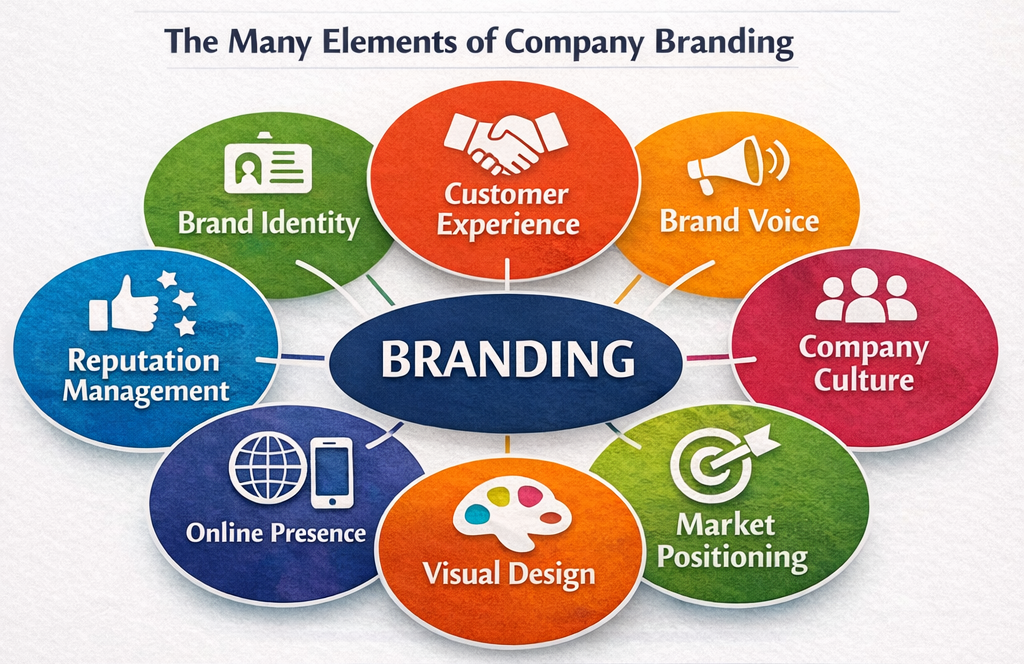
When most people hear the word branding, they immediately think of a logo, a color palette, or a catchy slogan. While these visual elements are important, they represent only a small fraction of what true company branding actually is. In today’s digital-first, experience-driven economy, branding is the sum total of how your business is perceived, experienced, and remembered across every touchpoint.
In this SEO- and SGE-optimized guide, we’ll break down why branding goes far beyond a logo, what elements truly define a strong brand, and how businesses can build a cohesive brand ecosystem that drives trust, loyalty, and long-term revenue.
What Is Company Branding, Really?
Company branding is the strategic process of shaping how customers perceive your business across emotional, visual, verbal, and experiential dimensions. It includes:
Your mission, values, and purpose
Your customer experience
Your messaging and tone of voice
Your online and offline presence
Your internal culture
Your reputation and trust signals
In short: branding is not what you say you are — it’s what people believe you are.
Why a Logo Alone Is Not a Brand
A logo is a symbol of your brand, not the brand itself.
Here’s why relying on a logo alone fails:
No emotional connection – Logos don’t build trust on their own.
No differentiation – Visual identity without positioning blends into the market.
No consistency – Without brand guidelines and values, messaging becomes fragmented.
No experience layer – Customers remember how you made them feel, not just how you looked.
Strong brands win not because of better logos — but because of clearer positioning, better experiences, and stronger emotional resonance.
The Core Pillars of a Complete Brand
1. Brand Strategy
Your brand strategy defines who you are, who you serve, and why you exist.
Includes:
Mission and vision
Core values
Unique value proposition (UVP)
Market positioning
Competitive differentiation
2. Brand Identity (Visual + Verbal)
This is where the logo lives — but it’s only one component.
Includes:
Logo system
Color psychology
Typography
Iconography
Imagery style
Brand voice and tone
Messaging frameworks
3. Brand Experience
Every interaction shapes brand perception.
Includes:
Website UX/UI
Customer service tone
Sales process
Onboarding flow
Product or service delivery
Support experience
4. Brand Communication
How your brand shows up in the world.
Includes:
Website copy
SEO content
Video marketing
Social media presence
Email marketing
Advertising creatives
Public relations
5. Brand Trust & Reputation
Modern branding is built on proof, not promises.
Includes:
Reviews and testimonials
Case studies
Online ratings
Media mentions
Thought leadership
Community engagement
6. Internal Brand Culture
Your employees are your first brand ambassadors.
Includes:
Hiring philosophy
Leadership style
Internal communication
Training systems
Incentives and values alignment
The Branding “Web”: How Everything Connects
Branding operates as an interconnected ecosystem — not a linear checklist.
Changes in one area ripple across the entire brand:
A shift in brand values affects messaging, hiring, and partnerships.
A redesign of your website changes trust, conversions, and perceived authority.
A new positioning statement alters advertising strategy and SEO targeting.
This interconnected structure is best understood as a branding web — a system where every node reinforces or weakens the others.
SEO and SGE Implications of Strong Branding
Search engines increasingly reward brand signals.
A strong brand improves:
Branded search volume
Click-through rates (CTR)
Dwell time and engagement
Backlink quality
Entity recognition in Google’s Knowledge Graph
For SGE (Search Generative Experience), consistent branding helps AI systems:
Understand your topical authority
Associate your business with trusted entities
Surface your content as a reliable source
Key Takeaway: Branding Is a Business System
A logo is just the face.
Branding is the entire body.
It’s your:
Strategy
Story
Experience
Reputation
Culture
Trust
When all of these align, your business stops competing on price — and starts competing on identity, meaning, and loyalty.
Final Thoughts
If your branding effort stops at a logo, you’re leaving massive value on the table.
Modern branding is a strategic growth asset — not a design exercise.
Businesses that invest in holistic branding:
Convert better
Retain customers longer
Command premium pricing
Attract better talent
Build defensible market positions
Your brand is not your logo. Your brand is your promise — delivered consistently.