

Traditional SEO is Dead
Let’s stop pretending. The SEO playbook from five years ago isn’t just outdated. It’s a liability.
If your marketing partner is still obsessing over keyword density, exact match anchor text, and backlink quantities, they aren’t driving your growth. They’re managing your decline. The game hasn’t just changed. The board has been flipped, burned, and replaced with something entirely different.
Here is why traditional SEO is fundamentally broken and what actually moves the needle today.
1. The AI Answer Engine is the New Homepage
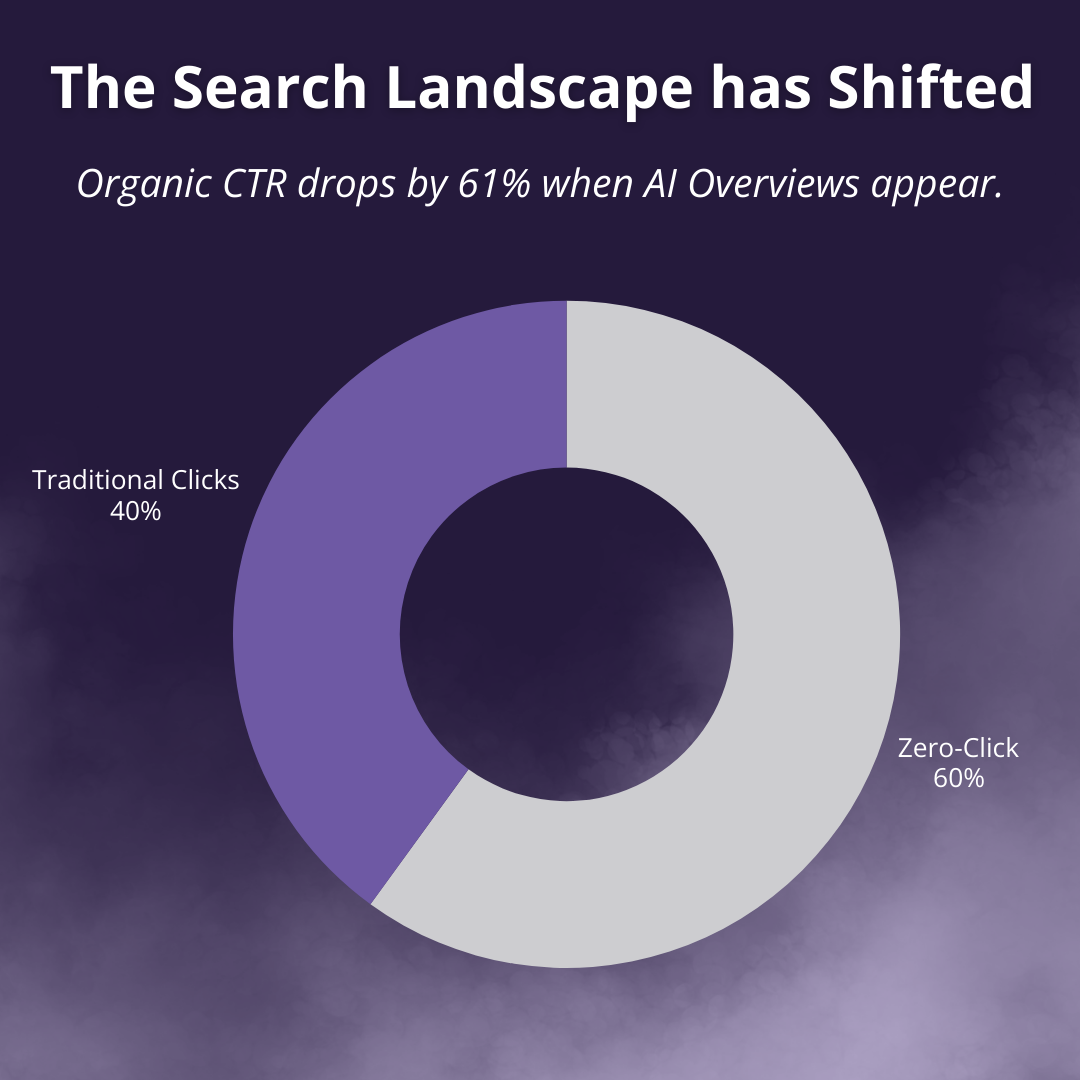
Google used to be a digital card catalog. You typed a query, and it gave you a list of links. Today, search engines have evolved into answer engines. With AI Overviews and generative summaries, Google wants to be the destination rather than the middleman.
The Problem: Roughly 60% to 65% of all searches now end without a single click to an external website [1]. If your content only answers "what is X," users have no reason to click through.
The Fix: Stop chasing the "what" and start dominating the "how" and the "why." You need to provide the nuance and human expertise that a generic AI summary cannot replicate.
2. From Search Results to AI Citations
In the past, the goal was to rank in the top three blue links. Today, the goal is to be the source that the AI cites. This is called Generative Engine Optimization (GEO).
When an AI Overview appears, traditional organic click-through rates (CTR) can drop by more than 61% [2].
However, brands cited in AI Overviews earn a 35% higher organic CTR than those that are not [3]. You don't just need to be on page one. You need to be inside the answer.
3. Keywords are Dead. Intent is Everything.
The obsession with ranking first for a specific phrase is a vanity metric. Modern search engines use semantic understanding to group queries by user intent.
Traditional SEO tries to rank for words. Modern strategy tries to solve problems.
Younger generations are leading this shift. Roughly 43% of Gen Z search queries are now phrased as natural language questions rather than shorthand commands [4]. If your content does not align with the user's specific stage in the buying journey, you won't rank. Period.
4. The Content Farm Era is Over
For years, the strategy was simple: publish more to rank more. This flooded the web with "optimized" fluff. That era ended with the rise of AI-generated spam. Now, Google aggressively penalizes thin content.
The New Standard: Experience, Expertise, Authoritativeness, and Trustworthiness (E-E-A-T).
Authority is harder to fake than ever. A staggering 95% of all web pages currently have zero backlinks [5], meaning true earned authority is the only way to stand out in a sea of AI noise.
5. Zero Click Searches are the New Normal
A massive portion of searches now end without a single click. On mobile devices, this is even more extreme, with 77% of queries ending without a site visit [6].
If you’re measuring success solely by organic traffic, you’re missing the big picture. Modern SEO is about Brand Salience. Even if they don't click, did they see your name? Did you establish authority? SEO has evolved into a brand building tool.
How to Win in the Post Broken Era
To win today, you have to pivot from optimizing for search to optimizing for the person. Despite the shift in clicks, 49% of marketers still report that organic search delivers their highest ROI compared to any other channel [7].
Prioritize Experience: Lead with direct answers. Only 54% of websites currently meet Core Web Vitals standards [8]. If your site is slow, keywords won't save you.
Topic Authority: Focus on becoming the go-to resource for a subject instead of just a collection of phrases.
Optimize for AI Discovery: Use clear schema markup and direct language that AI agents can easily parse and credit.
The bottom line? Traditional SEO was about tricking an algorithm. Modern SEO is about earning a reputation.
